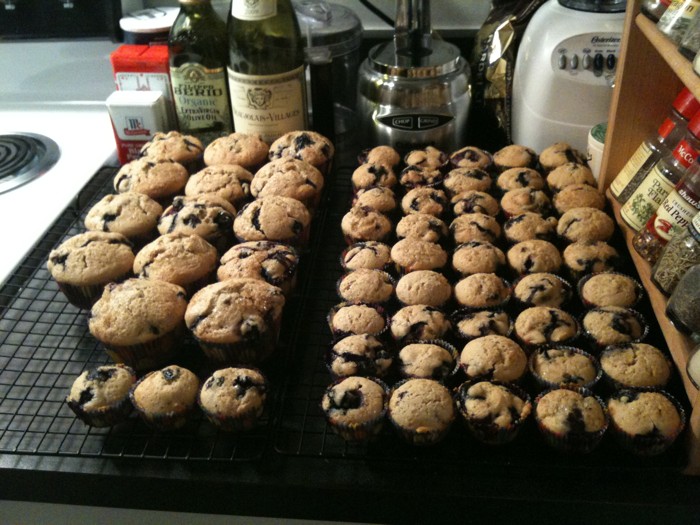
How much flour is fifty pounds of flour?

My friends (and lots of other people, too) know that I bake a lot. In my opinion, one of the biggest challenges of baking is acquiring the all of the necessary ingredients, and the heaviest burden is the sugar and flour (pun only partially intended). Especially when you live the city life without a car.

King Arthur Flour decided they wanted to make this part of the baking experience a handful more pleasant. Not only are their flours among the best available based both on quality and consistent quality, but one can order large quantities of their flours online without unreasonable shipping charges, which removes lugging ten pounds of flour from the grocery store on top of milk, eggs, meat, and produce from my weekly routine. It's an excellent marketing trick for them, too: in addition to brand loyalty, I never think twice about buying cake flour in addition to all-purpose flour because clicking that extra "add to cart" is much more convenient than spending some quality time with a sifter and ending up with only a reasonable approximation of what I actually wanted.

Unfortunately, even standard ground shipping isn't free. While there isn't a flat rate per order - entirely unsurprising as flours do weigh nontrivial amounts - you tend to get a better deal if you buy more flour per order. Let me say what I mean to say: I try to consolidate my flour orders into larger orders - orders that I expect to last about four months. As such, my last two flour orders have been upwards of fifty pounds. My last order (which should be arriving soon!) had fifty pounds of unbleached all-purpose flour alone.

"Holy flour, Batman! Fifty pounds of flour over the course of four months?" Well, I bake a lot. But it's been very hard for me to quantify what "I bake a lot" actually means in terms of pounds of flour because we generally think of baking in terms of tablespoons and cups. The internet combined with some basic math leads me to believe that fifty pounds of flour works out to about 200 cups, but 200 is still a sufficiently large number of cups that it is hard to fathom in terms of delicious, ready to eat baked goods.

To help quantify what fifty pounds of flour really is, I've created a Twitter account, @cupsofflour, to track both how much flour I buy and how much flour I use in each baked good I create. I know that it won't answer the question "how much flour is fifty pounds of flour?" as accurately as I might wish because I won't just be tracking my consumption of all-purpose flour (though I will be certain to distinguish what types of flour I'm use each time I bake) and because I rarely actually let my cabinet run out of flour completely (though I was completely out of all-purpose flour for about four days last week). I'll try to post a picture accompanying the type and measurement of flour in attempts to paint the most complete picture. Also, so that I can overwhelm you with my baking habits.

Better with Star Wars, baking is

Isn't everything?

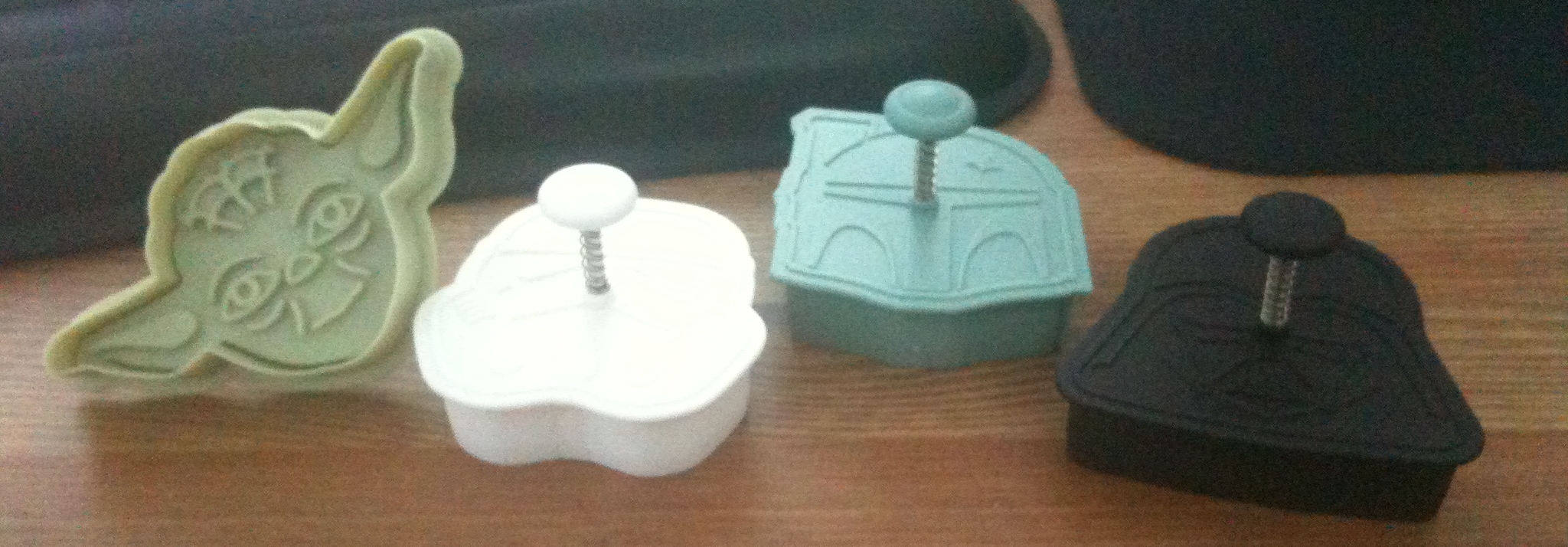
Star Wars partnered with Williams-Sonoma to make pancake molds and some rather insanely high quality cookie cutters:

Star Wars cookie cutters: Yoda, Stormtrooper, Boba Fett, Darth Vader

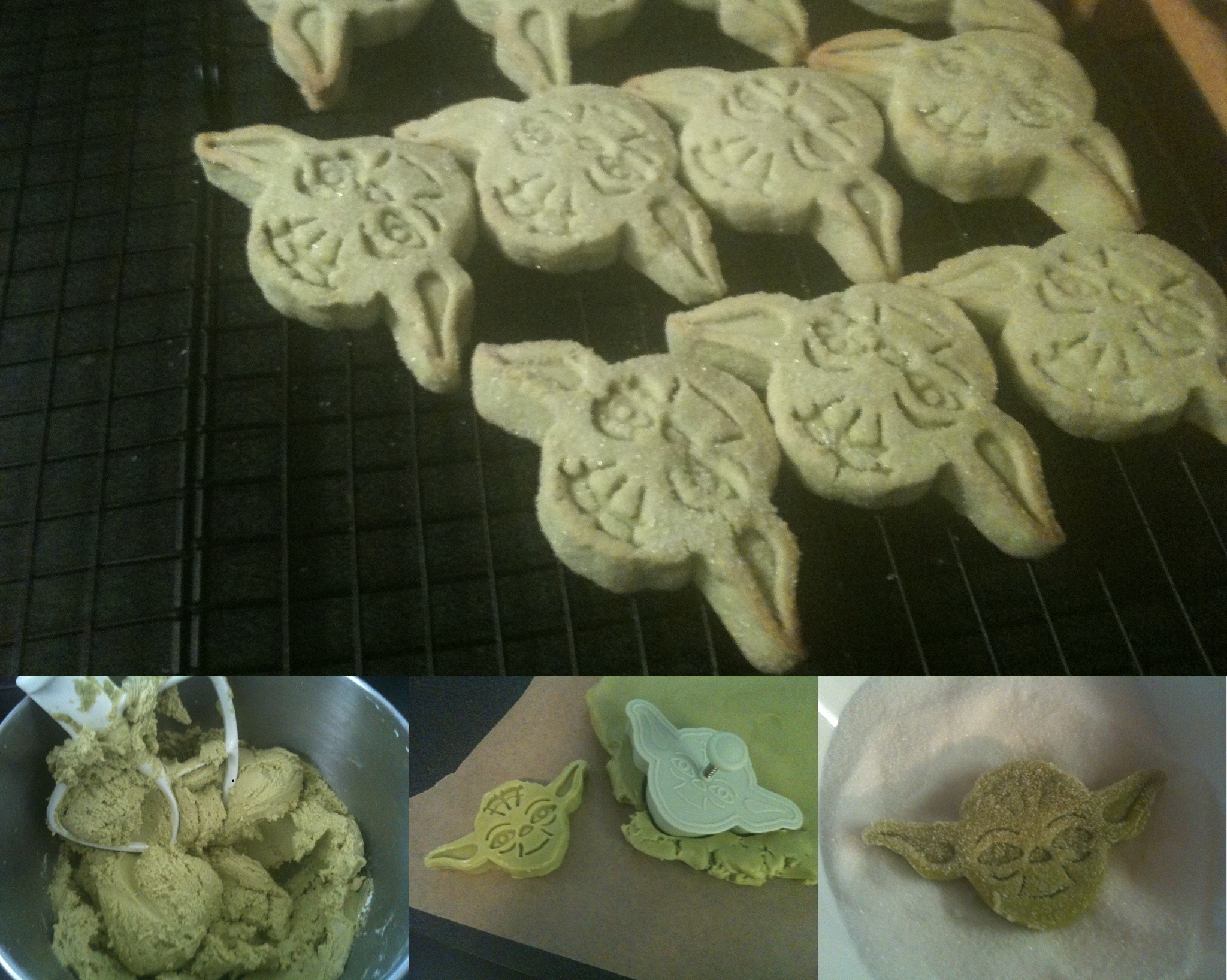
The set of four includes a Yoda face and helmets from each of Darth Vader, Boba Fett, and a stormtrooper. I knew that if I ever got my hands on these, I'd have to make Yoda green tea cookies to optimize for both cuteness and deliciousness.

Yoda green tea cookies

Once upon a time, there was a (really just mediocre) tea store on Newbury Street called Whittard of Chelsea. While the tea was not very impressive, they did stock these amazing tea sweet cookies by a now closed store called Amai Tea and Bake House. I can't vouch for the quality of their tea either, as I've never had it, but their green tea cookies were simply amazing.

When I found out I could no longer buy these cookies (as I mentioned, Amai closed), I decided to try and recreate these cookies by modifying a shortbread recipe. Of course, I had to add the green tea flavor, so matcha green tea powder was the obvious choice. I recommend using a latte grade matcha powder because the flavor and bitterness of tea ceremony quality matcha powder will be drowned out by the sugar in the dough. Amai's cookies were much smoother than a standard shortbread, so I used cake flour and confectioner's sugar instead of oatmeal or all-purpose flour and granulated sugar. Finally, they were clearly coated in granulated sugar before baking. You can play along with the recipe below; it makes roughly 36 Yoda cookies. These also make for some adorable Christmas tree cookies when the holidays roll around.

Green tea cookies

Ingredients:

  • 3 tablespoons and 1 teaspoon matcha powder
  • 1 and 2/3 cups confectioner's sugar
  • 2 and 1/2 sticks unsalted butter cut into small (tablespoon sized) slices
  • 3 and 1/4 cups cake flour (you can substitute all-purpose flour)
  • 6 large egg yolks
  • About 1/2 cup of granulated sugar

Preparation:

  1. Preheat the oven to 350 degrees if you don't plan on chilling the dough.
  2. Whisk the matcha tea powder and confectioner's sugar together. Using a stand mixer with the paddle attachment, cream this mixture with the butter.
  3. Add the flour and mix until combined. The texture should now be crumbly.
  4. Add the egg yolks and mix until fully incorporated. The dough should now be very smooth.
  5. Chill the dough in the refrigerator until firm and cool throughout. I usually let the dough chill overnight for convenience, but a couple of hours is definitely sufficient.
  6. Roll the dough out until it about half an inch thick. Cut out cookies, toss each in a bowl of granulated sugar to coat, and place onto a parchment paper lined baking sheet. Bake for roughly 11 minutes at 350 degrees. The cookies are done when they have just turned golden at the edges.

Yields roughly 36 two inch cookies.

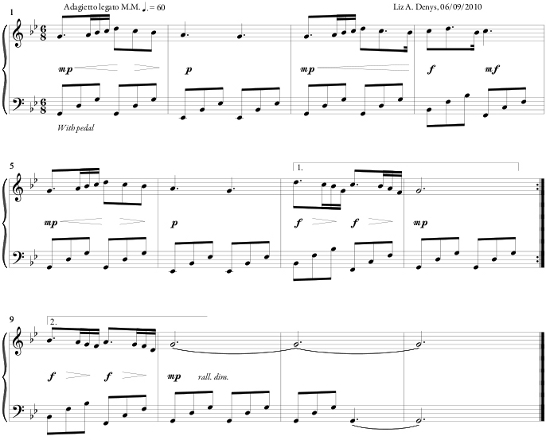
6/8 time, beat on the dotted quarter, 60 bpm

My subconscious seems to be running in 6/8 time with the beat on the dotted quarter and 60 beats per minute; at least, whenever I sit down at a piano without sheet music in front of me, I always converge on that setting. Sometimes, I write some of these musings down:

The had I feared score

I've mentioned before that I struggle to title compositions, so I titled the short piece above, which reminds me of a Renaissance dance, with another short stanza:

Had I had a fear of heights, maybe,
maybe the view would stick
and reflect in the corner of my eyes.

You can grab a pdf of the score.

L'Insurrection qui vient

I can trace different periods of my life back to the music with which I decided to fill my ears and the stories towards which I let my eyes venture. Rereading tends to bring a part of me back to previous points in times, and occasionally, I partake in this.

But there are few books I revisit often. Because only a few books are composed of words that affect me differently during each read.

The Coming Insurrection book covers

L'Insurrection qui vient (The Coming Insurrection) is one of those books. I picked it up just over a year ago at the MIT Press Bookstore on a whim. Little did I know that the book would get so much attention a few weeks later: an impromptu book-reading in New York attended by the police, condemnation on a Fox News broadcast as "the most evil book...in a long, long time", and accusations that it indirectly caused massive raids with helicopters and anti-terrorist police.

The Coming Insurrection examines the tenants of Western politics, philosophy, and lifestyle - and immediately dismisses them. It's not a light read, but it's playfully worded. Even if you are so rooted in your beliefs that the book won't change them, it will shake your way of looking at them because you probably will have never before confronted a view so staunchly opposite that of your upbringing in every single way.

Each time I've read this book, I've been alarmed, confused, put off, you name it. (Even when reading it in the poetic original French.) But even though the words are clear, strong, and ever the same, it pushes me differently each time.