I've been biking for transportation for a few months now, and honestly, I've never been a happier person. That said, it took a while to go from very comfortable riding a bike around the car-free loop inside Prospect Park to no longer feeling extremely anxious riding on NYC streets. I figured I should share some of the things that I've learned before I forget that they're worth passing on. (I'm also curious to look back on these thoughts in a year or so.)
I certainly didn't magically figure any of this out on my own: I'm very lucky to have started biking in NYC with the support of my partner Matt and my bff Geoffrey. I am forever grateful for their encouragement and guidance.
NYC biking basics/knowing the rules
- NYC DOT official resources
- Transportation Alternatives's Biking Rules is a bit dated, but a quick read with a lot of knowledge. TA also has a page full of NYC bike resources.
- Bike New York has a lot of information in their Virtual Bike Education Resource Hub, and I found the series of short videos titled "Bike Education At Home" particularly helpful.
- All of the above resources say this, but it bears repeating: pedestrians always, always, always have the right of way.
What to wear
- I dress for biking almost the same as how I dress otherwise for the same weather, but of course, I also wear a helmet! You will generally get warmer from biking than walking: I might wear one layer fewer, but I pack that layer in my bag in case something happens to my bike and I need to fix a flat or walk it to a shop. This is also really helpful when your destination is outside!
- It's a lot more important to make sure your hands are warm while biking since you can't just stick them in your pockets. When I start wearing a heavy hoodie, I need to start worrying about keeping my hands warm while biking - even though I rarely wear more than fingerless gloves when I'm walking and it's freezing out. I also found this winter biking zine extremely useful for how to dress to bike in freezing temperatures. In my experience so far, the hardest thing about biking when it's freezing out (but there's no snow accumulation) is making sure you're dressed properly to bike in that weather.
Getting started
- I rode a bike for fun as a child, and I used to ride a bike in Cambridge, MA a decade ago. At the time, the streets I frequented in Cambridge were a lot quieter than NYC's. I started here by riding Citi Bikes around Prospect Park with my partner and a close friend. The space for bikes there is wide and mostly car-free. Other large parks in the city have car-free spaces for biking, too, but Prospect Park is close to me so I can bike it everyday. It was a good place to get used to riding with cyclists going different speeds. I got comfortable biking while only holding on with my right hand so the other could be free to hand signal turns and stops. I practiced scanning, signalling, and scanning again as I turned without worrying about the risk of cars. I worked on keeping a steady distance from the marked lane lines until I felt confident I could go through the narrowest bike lane on NYC streets easily.
- After I felt ready to bike on the road, I started by only biking to places I've walked many times before and knew exactly where the bike lanes were, what they looked like, and how they worked at intersections. I took all of these first trips with my partner or my best friend. After a few rides, I was no longer nervous about biking these on my own.
- After that, when biking on less familiar roads, I made sure to take my first few rides with friends. When I started feeling less like I was riding along with them and more like we were riding together, I started feeling ready to do this on my own.
- There is never shame in riding e-bikes, and Class 1 pedal-assist bikes (including Citi Bike's electric bikes) ride very much the same as traditional, non-assisted bikes but make hill climbing a lot easier. They also extend your range and allow you to show up to your destination a lot less sweaty.
- I did not feel comfortable riding with my saddle (seat) as high up as is ideal at first. I am glad it's at the right height now (it's a lot less stress on my knees!), but I am also glad I let myself gradually work up to it (it's good to not force yourself out of your comfort zone before you're ready!).
Route planning
- It's worth looking at the NYC Bike Map whenever you're planning a new-to-you ride as map apps don't seem to fully understand how to suggest bike routes based on it. The NYC Bike Map shows protected bike lanes, conventional bike lanes a.k.a. paint lanes, shared lanes a.k.a. sharrows, and signed routes. Shared lanes and signed routes are nothing infrastructure, and I don't find it useful to consider them differently from unmarked streets while biking. The map doesn't seem to get updated every time new lanes go in, so you might be pleasantly surprised to find a new bike lane that's not on the map.
- Sometimes walking my bike on the sidewalk to go the wrong way down a one way road or just down a stretch that seems exceptionally difficult to bike is worth it to me. Sometimes, this is even a useful shortcut! I especially appreciated doing this to avoid making three left turns when I was starting out.
How to navigate lanes
- You're supposed to stay in the bike lane when it's available and not blocked and you're not turning off that road.
- Most protected lanes in NYC are parking protected lanes. They provide more protection than just paint, but not as much as the name implies. Drivers often don't pull into and out of these parking spots while thinking about the bike lane next to them, and sometimes, they even choose to make incredibly deranged choices like using the space between two cars and the bike lane behind it in three-point turns.
- When there isn't a bike lane, you need to ride where you are safely out of the danger of being hit by a parked car's door opening suddenly. (This is also a danger in designated bike lanes, but you have less choice as to where to bike within the designated lanes as they are usually very narrow.) You also need to be visible to cars driving in the lane you're sharing, and if there's not room for a car to pass you safely, you want to take more of the lane so that they are not tempted to dangerously squeeze past you. Bike New York's "Where to Ride on the Street" video explains where in a lane you should ride to stay safe and be seen. (DOT's Bike Smart brochure, linked above, says you should ride on the arrows of the sharrows, but I'm not convinced that these arrows are always as thoughtful as that brochure claims.)
- Drivers tend to speed and otherwise drive more erratically down travel lanes that are wider.
- Long vehicles like trucks and buses aren't always able to see you when you're biking next to them, but their ability to see you isn't the only issue. One particularly dangerous place to be is by the side of a bus, truck, or other long and flat-sided vehicle, even if it is moving extremely slowly. If it moves into your space, you can get completely trapped in a way you're unable to escape - even if you come to a sudden stop immediately because, unlike with a car, it won't move forward clear of you. To stay out of this danger zone, you need to be completely behind (or in front of, but that's harder to control) these vehicles, not right by their window side.
How to navigate intersections
- Gear down when approaching a stop so it's easier to start again. You don't necessarily need to gear all the way down to make it easy to start, and I figured out which gears I feel comfortable starting from in the park so I wasn't figuring this out next to overeager cars. Before doing this, I wasn't really sure which gears were easy to start from. Unfortunately, you can't gear down on most bikes after you've already stopped. Remembering to gear down while I was still pedalling and approaching the intersection took conscious practice to become a habit. I feel a lot safer now that I consistently start more quickly at intersections.
- You might ride up to the right or left of a stopped car at intersections on streets without bike lanes. To be seen, you probably want to go in front of them instead of staying to their side, but don't block the crosswalk.
- Some intersections have leading pedestrian intervals (LPIs), which means the pedestrian walk signal changes to walk before the traffic light turns green to give pedestrians a head start. In NYC, bikes are allowed to use the LPI, but cyclists should obviously still yield to pedestrians. I'm fairly comfortable using this interval to go straight or take right turns, assuming there are no pedestrians in the crosswalk. I still find it tricky to make left turns safely on the LPI since I don't know how long it will last and cars tend to be over-eager to start as soon as the light turns green. Also, some cars and trucks, at least in Brooklyn, aggressively and illegally use LPIs as their own personal left turn signal without checking for pedestrians or people on bikes.
- There are two ways to turn left, commonly called "pedestrian style" and "vehicular style." I usually make pedestrian style turns instead of vehicular style turns at any at least slightly busy intersection because I don't feel safe waiting in the middle of intersections or crossing multiple lanes to turn.
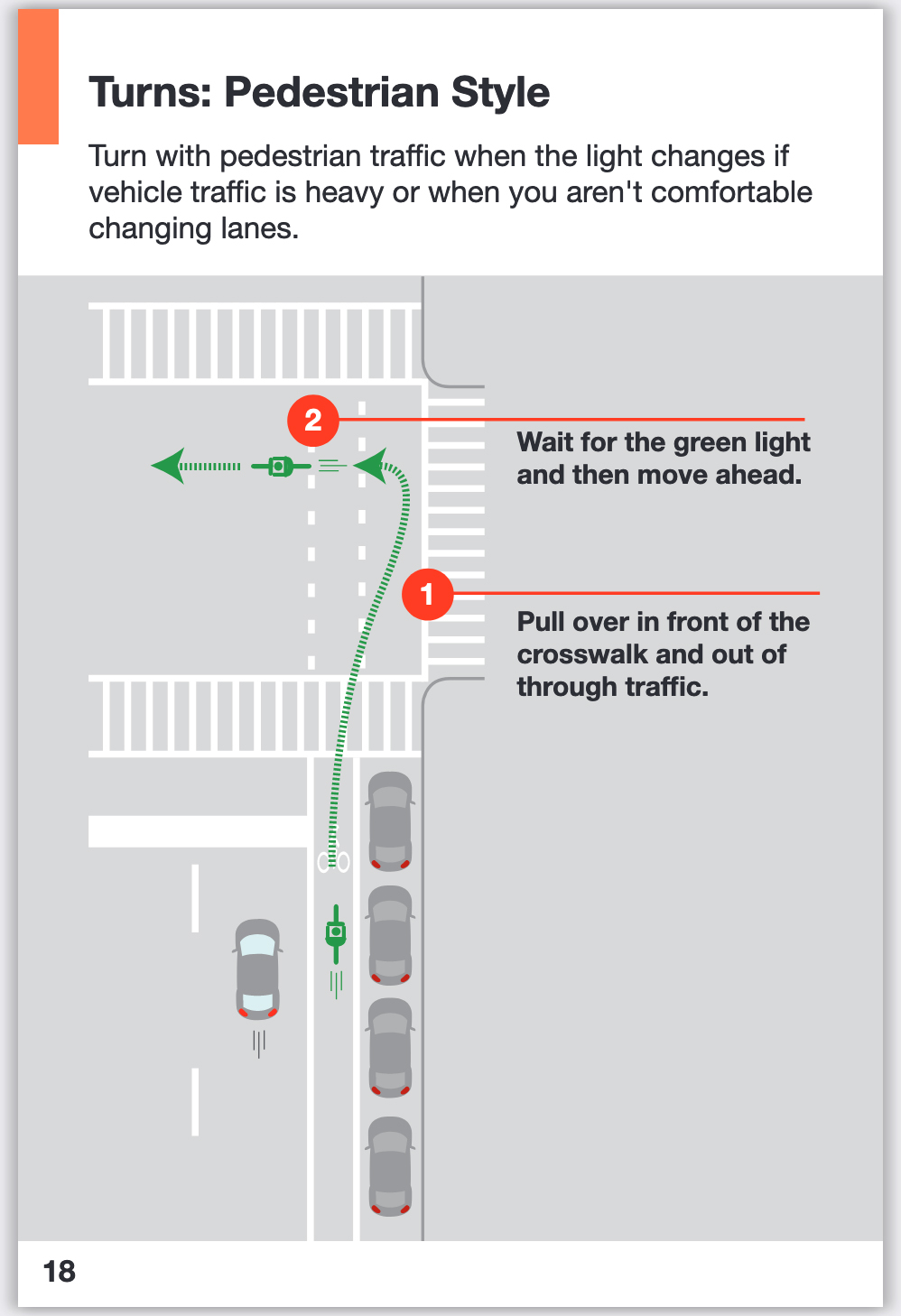
Illegally parked cars and other obstructions
- It's obviously terrible when cars or other obstructions block bike lanes and you have to go around them. It's also extremely dangerous for cyclists, even cyclists in bike lanes, when anything blocks any nearby lane because cars will often swerve around them - and into you - without looking. When I see one, I mentally prepare myself for a sudden stop, and scan the street to see if I can continue biking straight without a car coming at me.
- Bike lane or no bike lane, you want to pay close attention to where cars might turn into your path. Cars don't always look before pulling into an open parking space or turning out of a driveway. Taxis, Ubers, and Lyfts often stop pretty randomly without warning, and their occupants may open doors without looking. Cop cars behave particularly erratically since turning on sirens (or not) seems to mean they can ignore any rule.
- Buses usually don't stop for very long, so it's not always worth finding a way around them.
- Bike bells, even loud, resonant ones, aren't as effective on their own as also screaming loudly when a car is coming at you or someone else. I take no pleasure in screaming at drivers (and the occasional stares from confused onlookers who were lucky to miss seeing the crash that almost happened), but it's worth it to try to keep a close call from becoming a possibly deadly crash.
- Near misses truly freak my body out. I thought this would lessen over time, but it hasn't yet. If it's easy to pull over for a minute to take deep breaths before starting up again, I will. (It usually is.)
I realize some of this information is a bit morbid - after all, riding a bike in NYC isn't anywhere near as safe as it should be. I am generally an anxious person when it comes to doing things that potentially have very terrible consequences, so I really cannot explain how biking is the one thing that doesn't constantly flood my thoughts with anxiety while I'm doing it! Instead, it just brings me joy. It's okay if that's not true for you: you know your own comfort level best.